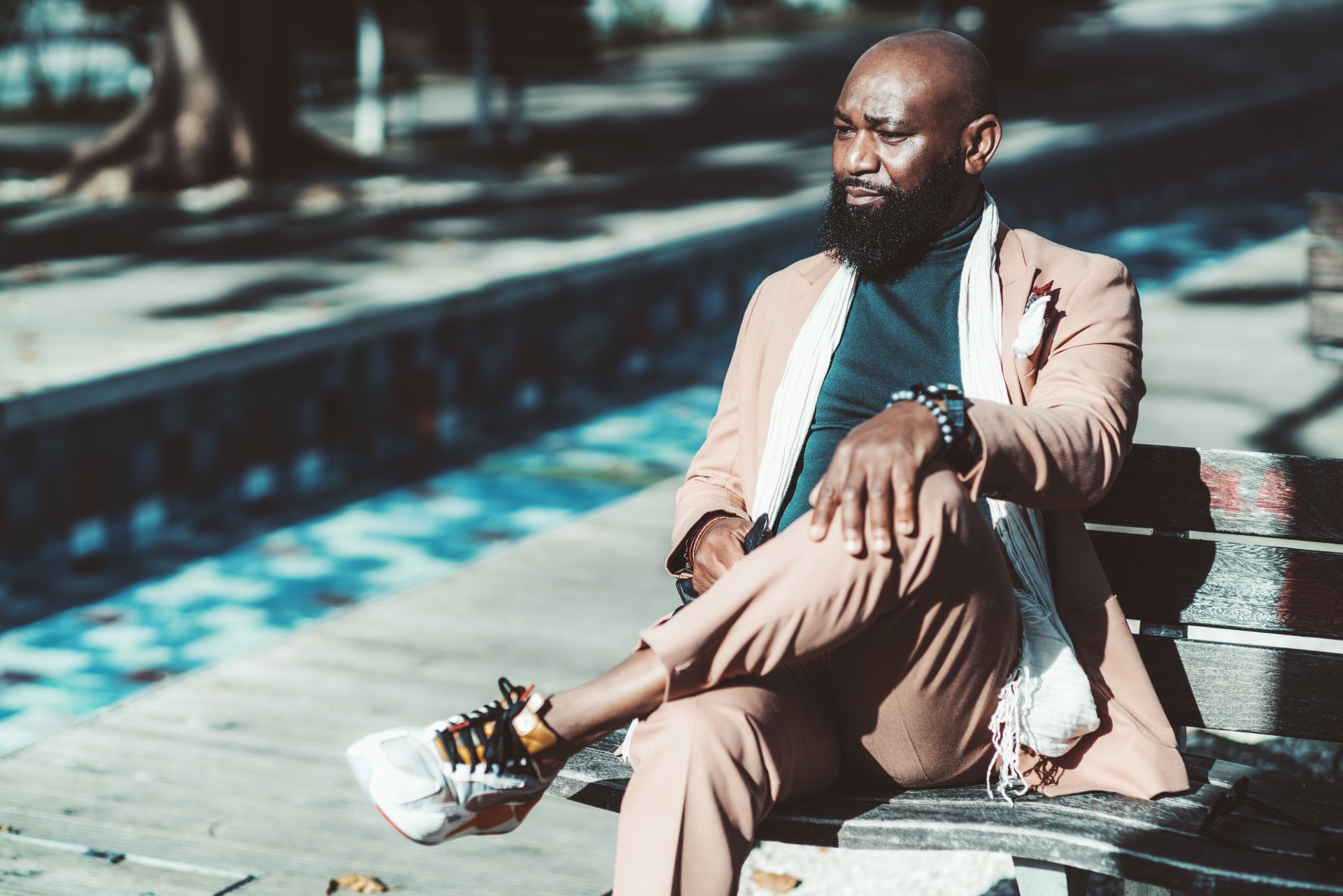
I arrived at my interview for a corporate law position feeling pretty good about myself. I wore a charcoal grey suit, painstakingly selected at Men’s Wearhouse. I had spent an embarrassingly large amount of money on it after convincing myself it was “investment-graded professional apparel” at the urging of a particularly aggressive sales associate.
Thirty seconds into the reception area of the law firm, however, I realised my upscale charcoal jacket was now glowing purple under their fluorescent lights. Purple. As in, not-dark-enough-to-be-charcoal purple.
Not dusky purple, or plum. Purple.

The managing partner saw me walk in and literally did a double take.
I spent the entire interview trying to keep eye contact with him, yet every few seconds I could catch him staring at my lapels in bewildered silence. Spoiler alert: I did not get that job. Needless to say, that wasn’t my only mortifying outfit-of-choice during job interviews.
Oh no. This was but one egregious episode during my now-infamous “ learn-from-impossibly-expensive-mistakes ” interview wardrobe phase. College roommate Derek showed up to interview for Goldman Sachs wearing flops.
Actual flip-flops. His logic? “They’re hiring me for my brain, not my feet.” Sound familiar? And I once had to stop my friend’s boyfriend from wearing his tuxedo shirt to interview at a startup because “it’s the nice-est shirt I own.” Listen, I’m not saying your outfit determines your qualifications as an employee.
You can craft the shiniest pivot table in Excel while wearing stained sweatpants. But we don’t live in a perfect world, and studies have shown appearance *does* matter when it comes to getting hired. So here’s the good news: I have spent years standing on the hemipherious of interviews with friends, stressing them out with questions like “Wait, WHAT SHOULD I WEAR?? ?” and I have developed a formula.
For better or worse, these are the dos and don’ts of interview attire across almost all industries. Corporate jobs: think law firms, finance, banking, consulting. This still means suits.
Suits. Suits for you. A nice dark blue, charcoal, or medium grey suit.
White or light blue button-up. Conservative tie. Conservative shoes.
If you have accents or accessories that will make you stand out, save them for your birthday party. Seriously. I had a friend named Marcus recently receive an offer from one of the Big Four accounting firms, despite the firm’s actual day-to-day dress code being business casual.
Why did he wear a navy suit to interview? “Everyone else who was interview- ing at my office was wearing suits,” he said. “It doesn’t matter what people there wear on a daily basis, you have to come in there, look at everyone in suits, and know you have to outdress them just to get in the door.” That being said, there are levels to this “corporate” standards, too. A regional insurance agency probably doesn’t dress quite as formally as Goldman Sachs. Your local law firm isn’t going to care quite as much about your attire as some stuffy firm in Manhattan.
When in doubt, you can’t be too fancy for a corporate interview. Creative careers: advertising, design, fashion, media. These industries couldn’t look more differently than corporate America when it comes to interviews, if they tried. “I showed up to interview with one of the top marketing firms dressed in what I thought was business professional,” recounts Liz, a marketing manager who has interviewed hundreds of people throughout her career. “Navy chinos, embroidered blazer, light blue button-up, no tie, and some suede desert boots.
I remember thinking I pushed it with the boots but that overall, I still looked ‘professional.’” She got the job. “And it turns out,” Liz laughs, “those boots ended up being a conversation starter with the hiring manager. She later told me she appreciated that I came in ‘looking put together but not corporate.’” Liz’s point exactly. If you interview at an advertising agency, fashion brand, or other creative company “business professional” attire will only hinder you.
You want to look like you would fit in with their culture, but also that you have a creative eye. And please for the love of God, do not show up in a full-on suit. So where does that leave you with all of these extremes?
Startups, smaller companies, businesses that don’t autumn into the above two categories. Banks, smaller tech firms, lots of companies these days consider themselves “business casual” for day-to-day work attire. And herein lies a wide range of interview appropriateness.
Business casual interview outfit rules: Dress trousers or nicer khakis Button-up shirt (yes, even at startups, button ups are your friend) Blazer optional Leather shoes, NOT trainers Aaaaaand we have a whole subset to touch on: tech. Don’t @ me tech companies, I know it varies wildly from “we wear hoodies to board meetings” to “AWS stands for Atmospheric White Shoes” levels of corporate. But in general, tech startups are less formal than your corporate positions and more formal than most business casual environments.
You Might Also Like

With one huge exception: location. A tech company in Chicago is going to dress significantly more formally than a tech company in San Francisco. My friend Kevin actually came up with what he calls a “tech standard uniform” for interviewing at startups after going through rounds at four different companies. “Dark jeans, no bleach or holes,” he said. “Solid colour button-up, sleeves slightly rolled.
Navy blazer that I can wear or not depending on the office dress culture. And what I like to call ‘Apple approves these trainers.’ Clean, minimal leather trainers.” He continues: “This get-up works for almost every interview. I can show up to Silicon Valley and be the best dressed guy in the room wearing this.
Or if I’m interviewing somewhere more conservative, I can leave the jacket in my bag and not be over dressed.” Even when interviewing at relaxed startups, there is a fine line between casual and “I didn’t try at all.” My rule of thumb: dark jeans, a well-constructed solid t-shirt or casual button-up, and clean minimalist leather trainers or boots. It looks intentional, not like you threw together whatever wasn’t covered in pizza from your floor. There are always going to be industry-specific quirks, of course.
Schools typically lean more conservative but not quite full-suite suits. Non-profits autumn more in line with business casual, though perhaps with a more formal touch for jobs in fundraising. And god forbid you work in healthcare administration… you’re still going to business attire even though your doctors are wearing h SCRUBS .
Again, though, no matter what industry you’re interviewing in there are some universal tips and tricks I wish someone had drilled into my head before I started interviewing everywhere. Do your research. Research the heck out of the company you’re interviewing with.
Carefully examine every photo on their website, Instagram page, and even LinkedIn profiles of employees. I even went as far as watching Instagram Stories of my interview location (yes, for an actual job interview) to feel out the office culture before walking in. You’ll get a good feel for what the interview attire should be by researching.
Consider your role. Client facing jobs will always require more formal attire than non-client facing. Leadership and management roles will typically dress more nicely than entry-level positions, even within the same company.
Location, location, location. This industry rule definitely applies to interview attire, too. The East Coast is generally more formal than the West Coast.
Urban offices typically dress up more than their rural counterparts. And for some reason, Southern cities tend to hold on to traditional business attire standards more so than Northern cities. I learned that firsthand when interviewing for similar positions in Austin, TX and Boston, MA.
Total opposite. Ask! This is your safest bet.
If you have access to a recruiter or HR contact at the company, simply send them a quick email: “I want to make sure I project the right image at my interview with you. What is typical interview attire for your office?” Please trust me when I say they will not think you are insane. They will think you’re smart.
Clean. Fits well. Isn’t distracting.
Whether it’s too casual, too busy, too wrinkled, or just plain weird, an interview outfit that falls into any of these categories will only hurt you. There have been far too many times I’ve interviewed in something that I later realised was distracting. Whether it be that purple “charcoal” suit I mentioned earlier or, once, this hilarious tie I wore with tiny cocktail glasses embroidered all over it.
It wasn’t visible from across the room, but upon closer inspection.. yep.
They were staring at my tie the entire time. Feels good.
I cannot stress this enough. Your interview attire should not only make you look good, but feel good, too. You need to walk into that interview feeling confident, prepared, and like a total boss.
Once you find something that makes you feel that way? HOLD ONTO IT. Merely saying, I have a friend named James – who, by the way, owns half the skyline because his family literally owns half the skyline – who wears the same tie to every single one of his “big” interviews.
And I’m not even kidding. “It’s been my lucky tie since I wore it and got my first big job offer,” he says. “I know it sounds stupid but I have to wear it now. It just makes me feel like I’m going to nail the interview.” You should feel that way during your interview. That, my friends, is the right outfit.